How System Design Becomes a GTM Moat in AI-First Era
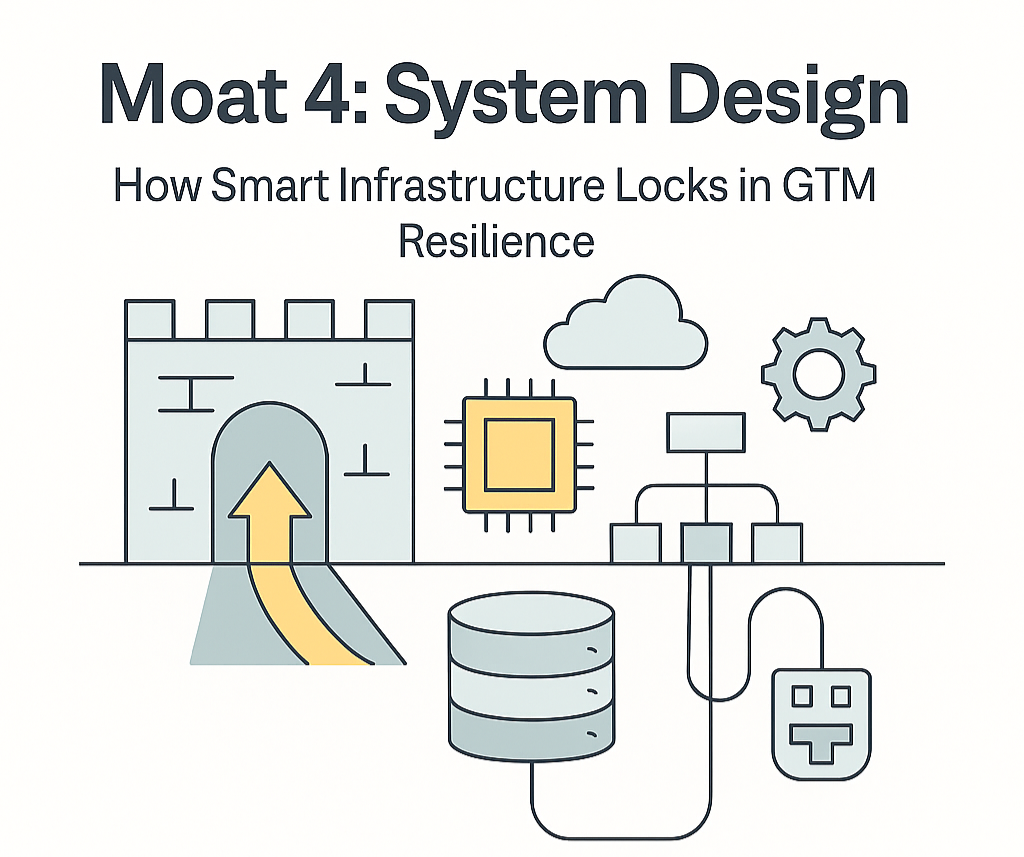
System design separates teams that rely on campaigns from those that build engines. In 2026, defensibility will come from workflows, measurement, and feedback loops that keep scaling long after the first experiment.
This is Part 4 of the AI Moats series. If you’re catching up, start with Moat 1: Data, Moat 2: Trust, and Moat 3: Distribution.
Each builds on the last, showing how GTM leaders in 2026 create advantages AI can’t wash away.
Most teams treat campaigns as the unit of work. They obsess over launch dates, creative tweaks, pipeline spikes. Then the team moves on, and the next campaign starts from scratch. There is no carryover, no accumulated intelligence. What creates staying power is something else — the wiring underneath. When signals keep flowing through systems instead of disappearing after a campaign ends, every part of GTM gets sharper. The value isn’t in the tools themselves, it’s in how the flow is designed.
Systems are about how fast you capture signals, how cleanly they move across functions, and how much learning stays in play. A campaign can be copied. A channel can be outspent. What cannot be cloned overnight is the pace and precision of a system that connects data, workflows, and people.
How operators build loops instead of one-offs
Think about a lead entering your funnel. In too many companies, that lead gets worked by an SDR, converted or dropped, and then forgotten. The insight about why it dropped doesn’t feed back to targeting rules. The patterns across dropped leads never inform product. By contrast, a team with real system design has that same lead flowing into one clean architecture where marketing, sales, and product can all see the path. The drop reason gets tagged. It updates scoring logic automatically. Over time, the system teaches itself what “good” and “bad” actually mean.
It’s the same with campaigns. A campaign that misses the mark in a high-functioning system doesn’t just die. Its signals trigger a change in audience criteria or channel mix before the next campaign launches. The lesson isn’t parked in a QBR slide. It lives inside the system.
Examples that show how this works in the market
Datadog built their motion around usage telemetry. Sales doesn’t wait until the renewal date to discover risk. They see anomalies in real time because product data flows into account dashboards. A dip in logins or a drop in active users can trigger alerts that route straight to account owners. Instead of looking at lagging pipeline reports, reps see live risk and expansion signals. That’s what makes the system powerful. A competitor can sell monitoring features, but without years of usage data flowing into those loops, they don’t get the same early warning signals.
Datadog observability
Canva looks simple on the surface — design tools spreading through organizations. The real engine is how enterprise usage is tied to onboarding, education, and expansion. When adoption is slow, education content is triggered. When adoption spikes, customer success teams see the pattern and push expansion. Marketing doesn’t operate in isolation; it feeds usage data back into support and product. This is why Canva moves upmarket effectively. It’s not a feature war. It’s years of wiring adoption signals into a feedback loop across teams.
Canva for enterprise
Atlassian has become a textbook example of product-led growth, but what makes it work is the system. Onboarding is automated, in-product nudges guide behavior, upgrades are triggered by usage thresholds, and support is woven into the flow. None of this looks flashy. It’s invisible infrastructure. Competitors can put freemium pricing on a site, but that doesn’t create the same engine. What holds is the way Atlassian turns individual user behavior into a signal that drives upgrades and expansion across accounts.
Atlassian PLG overview
Amplitude shows how analytics becomes part of the system. Their own GTM is fueled by the same data they sell. Behavior analysis doesn’t sit in reports. It feeds roadmap decisions. It shapes content marketing. It tells product where onboarding stalls. When those insights cycle back into the GTM engine, the company isn’t just running campaigns — it’s running loops. That’s why they’ve been able to position themselves as both a product and a proof point for how system design pays off.
Amplitude analytics
Questions operators should pressure test
- When a deal closes, does usage and adoption data flow back into targeting rules, or does it stay siloed?
- When churn happens, does the event trigger a cross-functional review automatically, or does it sit unexamined until metrics are pulled months later?
- How many steps in your funnel still rely on manual handoffs in Slack or spreadsheets? Each handoff is a leak.
- If a campaign misses its goal, how fast does that information shape the next one? Hours, days, or quarters?
Where teams lose the thread
A lot of companies confuse buying tools with building systems. They keep stacking dashboards and analytics platforms, assuming more visibility equals more learning. But without a flow, all those tools create noise. Others over-automate before fixing inputs, which means they lock bad assumptions into place and keep amplifying them. The mistake isn’t lack of technology. It’s lack of design.
Why system design becomes the edge in AI dominant world
AI makes campaign-level execution cheap. It makes creative, copy, and even outreach volume easy to copy. The teams that win are the ones whose engines get sharper with every cycle. You can replicate an ad in days. You can replicate a piece of content in hours. You can’t replicate the way a company wires signals into its workflows, or the way every team sees and acts on those signals in real time. That wiring takes years, and that’s why it becomes a moat.
CONTINUE THE SERIES
Moat 5: Community
Your GTM systems can run lean, but they reach a ceiling without people who advocate, teach, and defend your brand when you’re not in the room. In Moat 5 we’ll dig into how strong communities create resilience AI can’t copy, and why the best SaaS leaders treat community like infrastructure, not an afterthought.


Jahnavi Ray is a data obsessed marketing leader with 17+ years of experience driving demand, building GTM engines, and mentoring growth-stage B2B teams. She’s led marketing inside startups, scaled systems at global SaaS companies, and now shares her playbooks to help founders and marketers turn chaos into clarity, and pipeline into predictable revenue. When she’s not mapping growth ecosystems or coaching on GrowthMentor, you’ll find her practicing yoga, chasing her two gremlins, or building something meaningful in Toronto.