Request a diagnostic conversation
Most breakdowns don’t show up as obvious failures.
- Marketing volume is up, but unit economics are deteriorating as costs per qualified lead rise.
- Sales cycles are being wasted on "no-decision" behavior instead of high-intent buyers.
- RevOps provides activity snapshots but lacks the downstream visibility required to forecast growth.
Teams are working harder than ever, yet growth remains volatile because the engine lacks a shared operating rulebook.
This audit identifies the revenue leaks and rebuilds the operating model to restore predictability before scale locks in unit inefficiency.
FROM ANALYSIS TO ARCHITECTURE: The GTM Implementation Blueprint
The architecture of predictable growth
Without strategic leadership, GTM systems default to fragmented vendor decisions that burn budget before insights can be gathered. This 5-stage sequence ensures every motion is anchored in financial logic and buyer validation before execution begins.
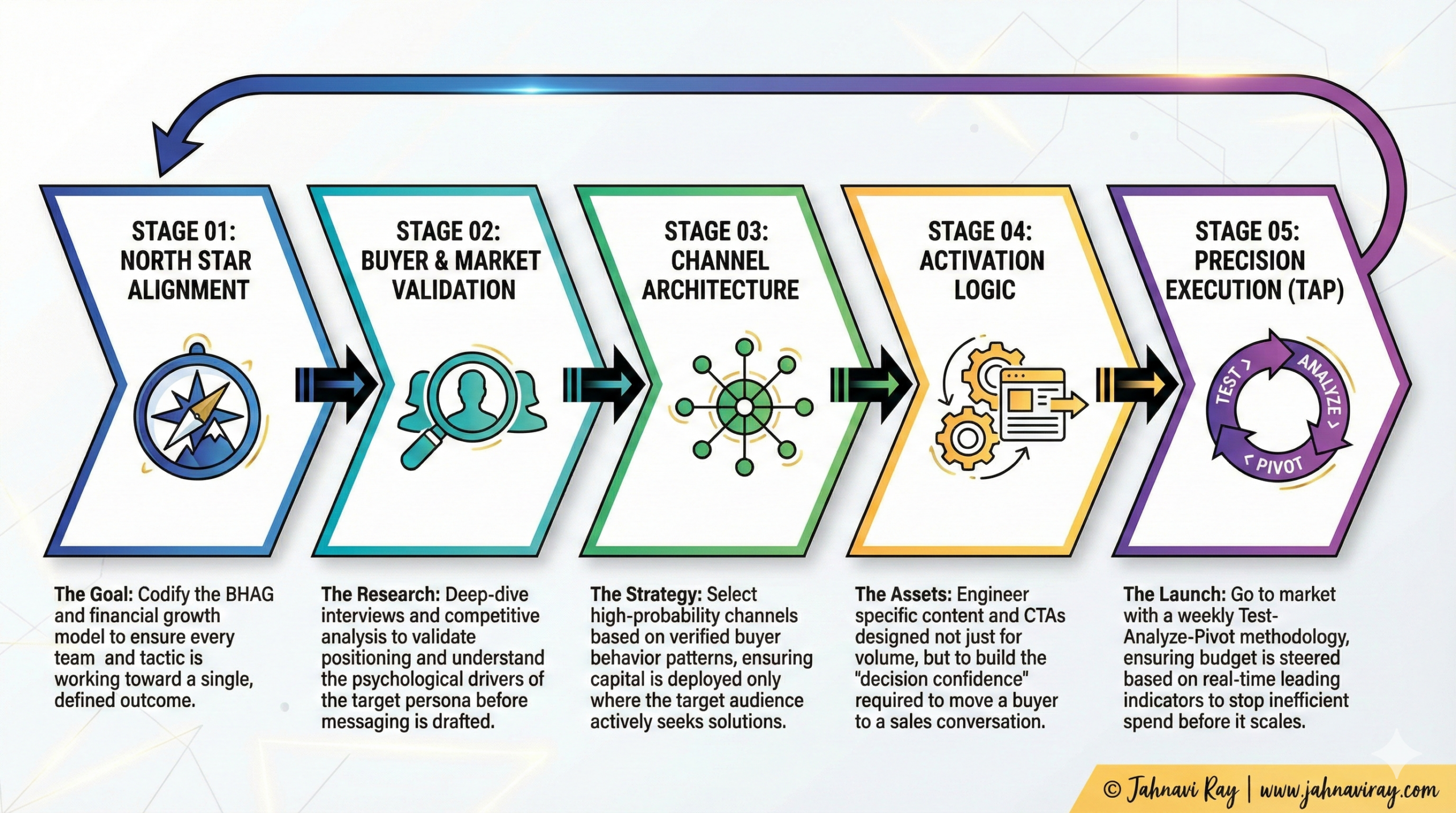
My Diagnostic Process: How I bring visibility
Building clarity
across the entire GTM engine
Analysis of how your GTM engine moves across channels, teams, tools, and buyer signals. You gain clear visibility into where momentum builds, where it slows, and where revenue quietly leaks.
Review qualification rules, routing logic, handoffs, metrics, and RevOps structure. You see how your teams support or block each other and what needs to shift to create predictable revenue lift.
How product, marketing, sales, and success work together to move deals forward with clear ownership.
- This covers handoffs, qualification, routing, data, and forecasting.
01
Funnel & Pipeline Performance
Stage-by-stage conversion points, drop-off behavior, and where buyers hesitate across stages
02
Positioning
&
Narrative
How your value story lands across marketing, sales, product, and every buyer touchpoint
03
Persona & Decision Psychology
What shapes buyer confidence, how stakeholders evaluate risk, and what influences commitment
04
Channel & Demand Health
How your demand channels build intent, and deal readiness
05
Lifecycle & Nurture Logic
Sequencing, messaging flow, and the logic that carries someone from first touch to commitment
06
Sales Motion & Handoffs
How deals move, what information gets lost, and what confuses buyers once they talk to a human
07
Qualification & Routing Rules
Where time gets wasted and where opportunities slip because rules lack structure
08
Data & Attribution
Whether your reporting shows truth or distorts it through averages, lagging metrics, or tool silos
Strategy Phase
The Plan that follows
Once the audit is done, the findings turn into an annual growth plan with defined priorities, timelines, KPIs, and budget decisions. The team gets a clear view of what to focus on and how progress will be measured across the year.
You see the core constraint in your GTM and the shifts required to remove friction. The plan establishes the outcomes that matter for the year and how each team contributes to them.
The plan outlines the specific moves that will move revenue forward. You see what needs attention first, which efforts should be slowed down or retired, and which motions will create the strongest lift.
You receive an annual model with quarterly priorities, monthly tasks, and KPIs tied to historic performance and ROI expectations. Teams understand their responsibilities, the timeline, and the metrics that define progress.

What differentiates me
I don’t operate from the outside
I move inside your GTM to see how revenue really behaves.
This gives me the context to find the friction and design solutions that are efficient to implement and easy to measure.
My approach to doing things differently
Most teams never get these elements in one place, which is why gaps stay hidden. This approach gives your leadership team clarity and gives your operators direction they can use immediately.
I’ve worked inside global enterprises, mid-stage SaaS, marketplaces, and high-growth teams, which means I understand how different systems behave and where they break. I bring ground-level experience and strategic depth that support data driven outcomes.
System-level view
You get a full picture of how your GTM behaves across teams, tools, and buyer signals.
Practical recos
Every insight ties back to revenue movement. You get a focused plan your team can execute without confusion.
Stronger GTM decisions
You build a GTM engine that is easier to manage, easier to scale, and easier to forecast because the structure finally supports your goals.